Untapped: Discovering Growth Through Hidden Talents
Welcome back to Thriving Thursdays with Tanisha, where we’re all about leaving you better, bolder, stronger, & wiser! This week’s focus is Untapped—those hidden gifts inside us just waiting for a chance to shine and that feeling of more that lingers like the fragrance after the rain.
Childhood Echoes: Piano Keys and Dance Steps
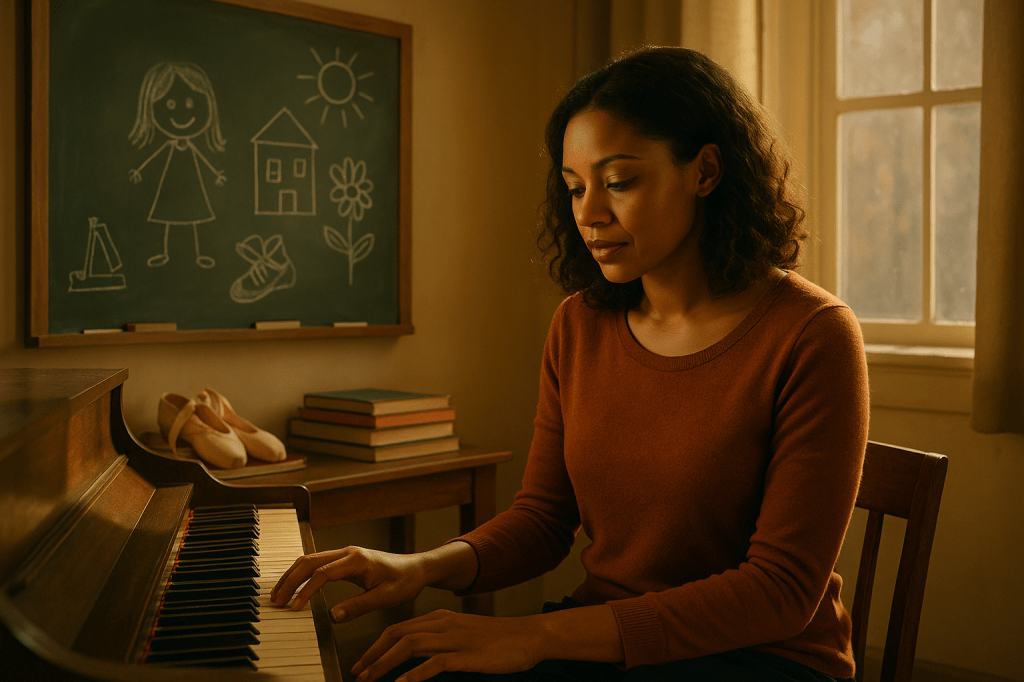
Almost like a gentle haunting, I remember the small piano that sat quietly in our home off Molynes Road—its black-and-white keys whispering promises of melodies I never learned. My parents loved me fiercely, and still do, but money was tight. So formal lessons never came. I never played a single real note—except on those tiny Christmas toy pianos with numbered keys and sheet music. Mine was pink, and I cherished it. “Mary Had a Little Lamb” was my only recital, but it was everything to me.
Fast forward to the experience at Merl Grove High school off Constant Spring road, where my classmates and I eagerly awaited our first dance class in seventh grade. For one glorious term, we leapt and swayed, discovering rhythm and confidence. But then family budgets shifted, and the music stopped. Another opportunity left unexplored.
As a young teen, I never voiced my desire for lessons. I knew my parents’ constraints all too well—and I believed my dreams would remain dreams with hope of becoming a vision one day. Like many of us, we are kept hidden in tupperware so tight we almost lose air.
Untapped Experiences: Shaping Our Adult Lives
Here we are today, and I see how those early “missed chances” still resonate that draws us into reflective moments with questions such as:
- Decision‑making: Do we hesitate when new opportunities knock, haunted by the ghosts of “I can’t afford it”?
- Relationships: Are we quick to compare ourselves to those who had the chance to bloom, rather than celebrating our unique journey?
- Self‑worth: Do we undervalue our abilities, forgetting that potential isn’t defined by past access, but by present action?
The good news is that all is never lost. Our stories of what wasn’t possible don’t have to limit what can be. We can pivot, reclaim agency, and choose experiences that nourish—not just whet the appetite, but sustain the soul. It’s your choice! It’s my choice!
Pivoting Toward Potential
Reflecting on this need to pivot, it dawned on me that while necessary for personal business adaptation, it can be challenging due to factors like fear of the unknown, resistance to change, and potential loss of momentum. Here, we are required to carefully plan, analyse, and be willing to embrace uncertainty. Here’s how we can start to tap into what’s been lying dormant:
- Acknowledge the Past
Give yourself permission to mourn missed chances. Recognizing the “what ifs” helps you move forward with clarity. Ensure you remind yourself that some untapped things don’t need to be revisited. - Reframe the Narrative
Instead of “I never learned,” try “I’m ready now.” Build an “I can learn” mindset, where resources—time, community classes, online tutorials—become stepping stones. Reframing also includes redirecting one’s energies and focus. Don’t limit yourself to yesteryears as there are new things on the horizon to tap into. - Start Small, Dream Big, Keep the Vision Alive
Sign up for a single session—an introductory keyboard tutorial, a dance workshop, or a free webinar. Small wins build momentum. Invest in YOU! - Invest in Yourself
Even low‑cost or no‑cost opportunities count: library books, YouTube channels, peer learning groups. Your determination is an investment every bit as valuable as cash. - Share Your Journey WISELY
When we speak our dreams aloud, we attract allies—fellow learners, mentors, and supporters who help hold us accountable.- Jamaican saying: “nuh everything good fi eat, good fi talk” is a proverb that essentially means – “not everything should be said”
Educators: Your Untapped Creativity Matters
Today, I want to speak directly to the educator who feels trapped in a curriculum cocoon, bursting with ideas but lacking the resources or approval to spread your wings. You’re not alone:
- You see potential in every child’s gaze.
- You dream of projects that blend art, math, social studies—and yet budgets and policies pull you back.
- You long to ignite that spark in students, even while your own spark feels faint.
Here’s the truth: When you tap into your own untapped creativity, the classroom transforms—and so does your own growth.
- Partner with colleagues to share materials and ideas.
- Host a “talents showcase” where both students and teachers demonstrate hidden skills.
- Use open‑source and community resources to pilot that innovative lesson you’ve been sketching.
By nurturing your own gifts—whether you finally learn that piano piece or dust off that dance routine—you model lifelong learning for your students. And in doing so, you thrive as much as they do.
Positive Psychology Insights: Reclaiming the Untapped Within
Understanding why our untapped talents matter isn’t just emotional—it’s deeply psychological. Here are a few key frameworks that affirm the importance of reawakening creativity, curiosity, and courage, especially in educators:
Self-Determination Theory
(Deci & Ryan)
At the heart of human motivation are three core needs: autonomy, competence, and relatedness.
When talents remain dormant, it often signals that we’ve lacked opportunities to express autonomy or grow competence. By encouraging ourselves as educators—and our students—to explore personal gifts, we nourish these psychological needs, fostering both motivation and well-being.
Jamaican Saying: “Every mikkle mek a mukkle.”
Meaning: Small steps toward expressing your talents and autonomy add up to something meaningful. Even limited opportunities can grow into competence over time.
Growth Mindset
(Carol Dweck)
A growth mindset teaches us that abilities aren’t fixed—they flourish through effort, support, and persistence.
Reclaiming our untapped talents, whether it’s picking up a forgotten skill or exploring new interests, is an act of defiance against limitation. It’s also a powerful way to model lifelong learning for the young minds we teach.
Jamaican Saying: “Wha nuh dead nuh dash wey.”
Meaning: What isn’t dead still has potential. Dormant talents can still thrive with time, effort, and faith.
The PERMA Model of Well-Being
(Martin Seligman)
True flourishing is grounded in five pillars: Positive Emotion, Engagement, Relationships, Meaning, and Accomplishment.
When we explore untapped parts of ourselves, we deepen our engagement, find renewed meaning, and experience the joy of personal growth. The impact ripples into how we relate to our students, colleagues, and ourselves.
Jamaican Saying: “Di joy inna yuh heart shine pon yuh face.”
Meaning: When we engage meaningfully and pursue what we love, our joy and well-being radiate outward.
Post-Traumatic Growth
(Tedeschi & Calhoun)
Adversity, including missed opportunities or financial limitations, doesn’t just take from us—it can also give.
Through hardship, many educators rediscover buried dreams or uncover new talents, leading to greater strength, gratitude, and clarity of purpose. It’s never too late to transform what once felt lost into something life-giving.
Jamaican Saying: “Trouble nuh set like rain.”
Meaning: Challenges come without warning, but they can shape us for the better if we choose to grow through them.
Pedagogical Theories: When the Classroom Becomes the Canvas
These educational theories affirm that the classroom is not just a place of instruction—but also a playground of potential, for both teacher and student:
Multiple Intelligences Theory
(Howard Gardner)
Not all brilliance fits neatly into a test score. Gardner highlights musical, bodily-kinesthetic, interpersonal, intrapersonal, and other intelligences often undervalued in traditional education.
Your story of missed dance and piano opportunities reflects a common reality: schools too often underfund or overlook these intelligences. Reclaiming them can reinvigorate both teaching and learning.
Jamaican Saying: “Every man a man, every hoe ha dem stick a bush.”
Meaning: Everyone has a unique gift or intelligence. Not all talents fit the same mold—and that’s a strength, not a flaw.
Experiential Learning Theory
(David Kolb)
Learning is a cycle—rooted in concrete experience, reflection, abstract thinking, and experimentation.
When teachers activate their own untapped talents—be it through art, music, movement, or mentorship—they model authentic learning. They show students that growth doesn’t end at graduation.
Jamaican Saying: “Who cyaan hear, mus feel.”
Meaning: Real learning often comes from experience. Reflection on lived moments teaches more than words alone.
Constructivist Theory
(Vygotsky & Piaget)
Learning is not a passive process—it’s built through experience and social interaction.
Inviting teachers (and students) to engage with unexplored skills or creative paths aligns with constructivist ideals. It says: Your voice, your story, your potential all matter here.
Jamaican Saying: “Di same knife weh stick sheep, stick goat.”
Meaning: Everyone—regardless of role—is shaped by what they go through. Teachers and students alike learn from shared interactions and experiences.
Critical Pedagogy
(Paulo Freire)
Education is not neutral—it either liberates or oppresses.
Recognizing and nurturing hidden talents—especially in under-resourced classrooms—is a radical act of empowerment. It disrupts cycles of silence and opens space for transformation, justice, and joy.
Jamaican Saying: “Tek sleep mark death.”
Meaning: Be aware and discerning. When education truly awakens hidden talents, it becomes a tool for liberation and foresight—not just survival. Oh What JOY!
What They Said…
As I revisit those quiet corners of my childhood—the untouched piano keys and the fleeting rhythm of a single dance term—I realize something profound: untapped potential doesn’t vanish. It lingers. It simmers beneath the surface, quietly shaping how we view ourselves, how we relate to others, and how we embrace or abandon our own possibilities.
For many educators, especially those working in under-resourced classrooms, this feeling is all too real. They carry deep wells of creativity, vision, and talent—yet often feel boxed in by curriculum constraints, systemic limitations, or even self-doubt. Still, growth is not only possible—it’s essential. Thriving is not a luxury—it’s a birthright.
To understand how we can reclaim and reawaken the parts of ourselves we once silenced, we turn to powerful insights from psychology and pedagogy. These theories offer both language and light for the journey toward the untapped.
Maslow’s Hierarchy of Needs (Self-Actualization)
Maslow reminds us that self-actualization—fulfilling our full potential—can only be pursued once our foundational needs are met. For educators, this means recognizing that creative expression and professional fulfillment are valid and necessary, not indulgent or optional.
Flow Theory (Mihaly Csikszentmihalyi)
Flow is that beautiful state where time seems to stand still and we’re fully immersed in what we love. Whether it’s teaching innovatively, mentoring students, or rediscovering a hidden talent, educators who are free to engage their strengths often experience flow—and when teachers thrive, students flourish too. This is the opportunity to CHOOSE growth.
Appreciative Inquiry (David Cooperrider)
Rather than fixating on deficits, Appreciative Inquiry urges us to build on what’s strong. This strength-based lens invites both teachers and students to recognize, nurture, and activate hidden talents. Tapping into what’s already within us can be the spark that reignites joy, purpose, and transformation. I hear the statement “Let the games begin”.
Educators’ Deep Dive
In classrooms where teachers are seen as curriculum deliverers only, their untapped talents become silenced. But when schools foster:
- autonomy, creative freedom, collaboration, and
- professional development that encourages personal growth,
teachers thrive. And thriving teachers grow thriving children.
Your Next Step
This week, I challenge you to identify one untapped talent or dream—big or small—that’s been waiting in the wings. Then “VISIONIZE” it:
- Write it down.
- Research one free or low‑cost way to explore it.
- Take one concrete action by Friday (e.g., register, watch a tutorial, borrow a book, ask a friend with the talent for help).
Share your progress in the comments below or on social media using #ThrivingThursdaysUntapped. Let’s build a community of bold explorers, proving that it’s never too late to discover what lies within.
Here’s to unlocking our fullest potential—together! 2 Timothy 1:6 (NIV) “For this reason I remind you to fan into flame the gift of God, which is in you…”
—NordiaTanisha
 Thriving Thursdays With Tanisha
Leave a comment